Leg swelling after flights and in hot weather: when to check your veins
Why legs swell in hot weather and during flights, which symptoms need assessment for a blood clot, and when ultrasound, D-dimer or travel prevention may help.
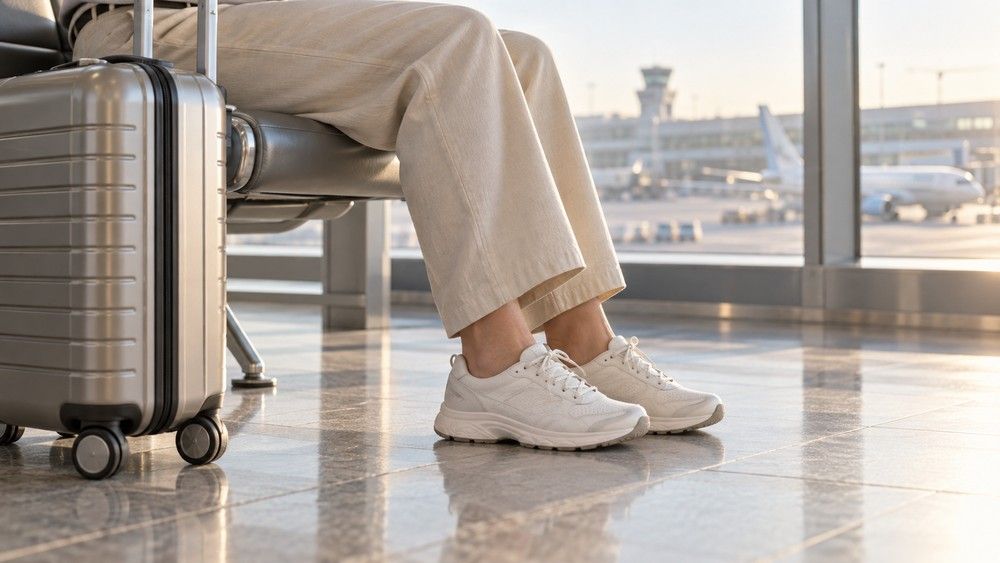
Leg swelling in hot weather or after a flight does not always mean vein disease: mild swelling in both legs can follow prolonged sitting or standing. Recurrent swelling, a noticeable difference between the legs, pain or skin changes need assessment. Sudden swelling in one leg calls for timely evaluation for a blood clot rather than waiting several days to see whether it settles.
Why does hot weather cause leg swelling?
Blood vessels widen in the heat to help the body release warmth, and blood flow to the skin increases. When someone stands or sits for a long time, gravity makes fluid more likely to accumulate in the lower legs and feet. Shoes may feel tighter by evening, and socks can leave marks on the skin.
This swelling is often symmetrical, affecting both legs to a similar degree. It develops or becomes more noticeable towards evening and improves substantially after sleep, rest or time with the legs raised. An episode like this does not by itself establish varicose vein disease.
Assessment matters when swelling becomes recurrent or one leg is noticeably more swollen than the other. Heaviness, tightness, pain, visible enlarged veins and changes in skin colour or condition are further reasons to check the venous system. Swelling alone cannot identify its cause.
Why do legs swell after a flight?
During a long flight, the calf muscles work less, although their contractions normally help return venous blood from the legs to the heart. Several hours of limited movement can cause mild swelling in both feet and lower legs, even in a healthy person. Prolonged immobility is also a risk factor for venous thrombosis.
A journey lasting more than 4 hours is generally considered long-distance travel. However, taking a flight does not in itself make a blood clot likely: the absolute risk of venous thromboembolism remains low in people without additional risk factors. Health history matters alongside travel duration.
People who have previously had deep vein thrombosis or pulmonary embolism need closer attention to prevention and symptoms. Other risk factors include recent major surgery or injury, active cancer, markedly limited mobility and known thrombophilia. Pregnancy, the postpartum period, oestrogen-containing medicines, obesity and combinations of risk factors also matter.
Which symptoms can suggest a blood clot?
Sudden swelling in one leg is particularly concerning, including after a long journey. If one calf becomes much larger than the other and there is pain or a feeling of tightness, assessment should not be delayed. Clinicians consider the combination of symptoms and risk factors rather than relying on a single finding.
One feature in the clinical Wells score is a calf circumference at least 3 cm greater than the other leg when measured at the same level. That difference does not automatically confirm a clot, and a smaller difference does not rule one out. It is part of a clinical assessment, not a stand-alone home test.
Concerning findings and combinations include:
- sudden swelling in one leg;
- calf pain or pronounced tightness;
- tenderness along the deep veins;
- a noticeable difference in leg circumference;
- pitting swelling confined to one leg;
- these symptoms together with recent surgery, prolonged immobility, cancer or a previous clot.
Seek emergency medical help if leg swelling is accompanied by sudden breathlessness, chest pain, a rapid heartbeat, coughing up blood, marked weakness or loss of consciousness. These symptoms can indicate a pulmonary embolism.
When are vein ultrasound and D-dimer useful?
Duplex ultrasound of the leg veins is the main investigation when vein disease is suspected. It assesses the deep and superficial veins, whether blood can flow through them and whether a clot is present. For chronic symptoms, it can also assess valve function and abnormal backward blood flow.
When acute thrombosis is suspected, the investigation pathway depends on clinical probability, which may be assessed using the Wells score. With low clinical probability, a negative D-dimer can help rule out thrombosis without unnecessary additional investigations. With high probability, vein ultrasound takes priority over trying to diagnose a clot from blood tests alone.
A raised D-dimer does not establish the diagnosis on its own. It can rise during pregnancy, inflammation, after surgery, with age and in other conditions. Ordering a D-dimer after every flight “just in case” is therefore not necessary.
A large panel of inherited thrombophilia tests is not needed for every person with swollen legs either. These investigations are selected for particular clinical situations. The diagnostic approach is described in the NICE recommendations.
What happens at a vascular consultation?
A clinician first establishes when and how swelling developed and relates this to the person's medical history. Important details include whether it began suddenly or gradually, affects one or both legs, appears in the morning or evening, or follows flying or prolonged sitting. Whether it improves after sleep is also relevant.
The consultation covers previous clots, operations, injuries, cancer, pregnancy and hormonal medicines. Family history of venous thrombosis is considered as well. Following examination, duplex ultrasound is performed when indicated.
If the veins are functioning normally, the next step is to look for another cause rather than continuing to treat the veins indefinitely. Swelling in both legs can be associated with medicines, heart, kidney or liver disease, thyroid dysfunction and other conditions. Swelling is a symptom, not a diagnosis in itself.
Are compression stockings or medicines needed before flying?
Healthy travellers without risk factors do not need to start aspirin or anticoagulants on their own simply because a flight lasts several hours. During the journey, get up and walk periodically when possible, move the feet and contract the calf muscles. Remembering to move is particularly relevant for trips lasting more than 4–6 hours.
Compression stockings are not necessary for everyone. For people at increased risk of thrombosis, a clinician may recommend properly fitted, graduated below-knee stockings. International guidance for higher-risk travellers considers pressure of approximately 15–30 mmHg at the ankle.
In selected situations involving a very high risk of venous thrombosis, a clinician may recommend preventive medication before a long journey. The decision is individual and balances clotting risk against bleeding risk. The CDC Yellow Book discusses prevention during travel.
When is a routine appointment appropriate, and when should you act sooner?
Mild swelling in both legs after a hot day or a long flight that almost disappears after sleep usually does not require an urgent vascular investigation. Recurrent or worsening swelling, heaviness, pain, enlarged veins or skin changes warrant a planned assessment. A vascular surgeon can decide whether ultrasound is needed and what should happen next.
Sudden swelling in one leg, particularly after flying, surgery, injury or a period of restricted movement, requires timely assessment to exclude deep vein thrombosis. Do not wait several days to see whether it goes away. The possible pulmonary embolism symptoms listed above call for emergency help.
Read about vein assessment and treatment on our varicose vein care page. If changes began after pregnancy, see the related article on veins after pregnancy. The aim of a consultation is to establish the cause of swelling and determine whether the veins are responsible.
Author: Dr. Nargiz Mamedova, MD, PhD — General Practitioner, Longevity Physician.