Childhood myopia: screens, outdoor time and eye checks
How screens, close-up work and family history relate to childhood myopia, with practical advice on outdoor time, reading distance and eye checks in the UAE.
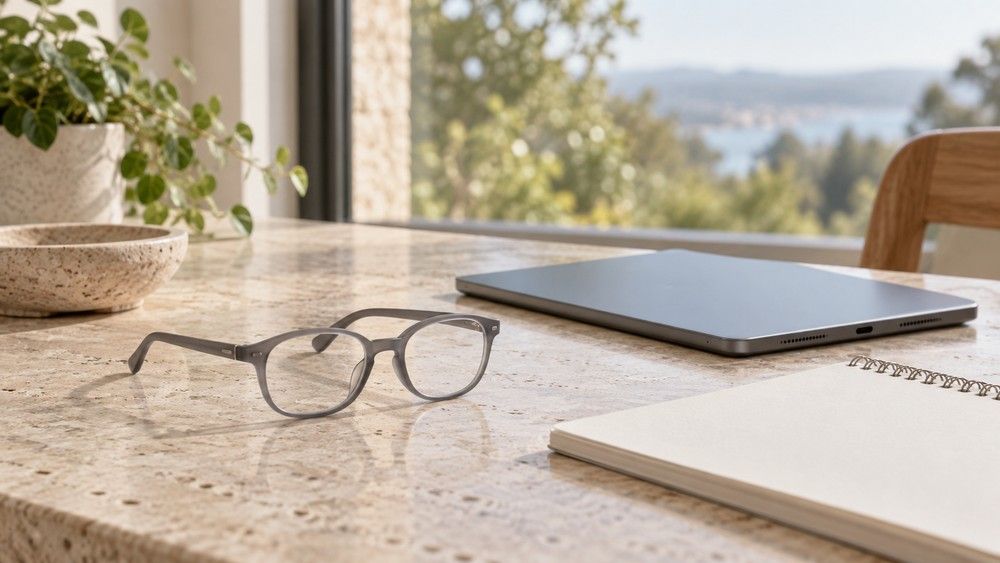
Childhood myopia is linked to more than screen use: family history, eye growth, prolonged close-up work and limited outdoor time all matter. Prevention therefore involves more than putting a phone away. Regular breaks, time outdoors and timely eye examinations are practical steps parents can take.
What is childhood myopia, and why does it develop?
Myopia, or nearsightedness, means a child sees nearby objects clearly but has difficulty seeing into the distance. It commonly develops as the eye grows longer, causing light to focus in front of the retina rather than on it. Myopia often starts during the school years and can progress as a child grows.
The earlier it begins, the more time there is for it to progress. Children do not always tell their parents that distant objects look blurred. A young child may assume that everyone sees the world in the same way and may not recognise a change as a problem.
Family history matters too: having one or both parents with myopia increases a child's likelihood of developing it. However, inherited risk is only part of the picture. Parents can still help shape everyday habits around outdoor time, breaks and close-up activities.
How do screens and close-up work affect eyesight?
Long periods of uninterrupted close-up work are associated with myopia risk, and screens are one form of that work. Reading, drawing and homework also involve focusing at a short distance. The combination of sustained effort, very close viewing and few breaks deserves attention.
This does not mean children should stop reading or completing schoolwork. The aim is to alternate focused activities with breaks and movement. Notice whether your child habitually brings a phone or book almost up to their face, rather than treating one particular device as the entire problem.
How much outdoor time should children have?
Spending time outdoors in daylight is one of the better-supported ways to reduce the risk of developing myopia. A practical aim is around 2 hours each day, particularly for preschool and younger school-age children. Building a regular outdoor routine matters more than treating it as an occasional activity.
In the UAE, outdoor plans need to account for the heat. Choose cooler morning or evening hours while there is still daylight, and use appropriate sun protection. Outdoor time for eye health should not mean prolonged exposure to intense sun.
Do blue-light glasses prevent myopia?
There is no convincing evidence that ordinary screen light damages a child's retina or is the main cause of myopia. Blue-light-filtering glasses are not an established way to prevent nearsightedness. Buying them does not replace regular breaks, a comfortable viewing distance or time outside.
Evening screen use may also disrupt normal sleep routines. This is a separate reason to review how devices fit into family life before bedtime. Our article on sleeping through the night discusses the wider importance of sleep habits.
What breaks and viewing distance help?
The 20–20–20 rule offers a simple way to interrupt close-up work: every 20 minutes, look at an object about 20 feet, or 6 metres, away for roughly 20 seconds. The aim is to develop a habit of shifting focus into the distance. During long homework sessions, standing up, moving around and changing activity can also help organise breaks.
Keep books, tablets and phones at a comfortable distance of approximately 30–40 cm from the eyes, with a computer monitor farther away. Avoid holding a device directly in front of the face. Make sure the workspace has adequate lighting.
These habits support a manageable visual routine, but they do not replace an eye examination. Breaks alone should not be expected to correct existing myopia. A child who struggles to see into the distance needs an assessment.
When should a child see an ophthalmologist?
An ophthalmologist should assess a child with new difficulty seeing into the distance or signs that may suggest myopia. Changes in behaviour can be a clue even when a child does not complain. Watch for:
- squinting when looking at distant objects;
- sitting very close to the television;
- holding books or objects close to the face;
- difficulty reading the classroom board;
- complaints of blurred distance vision;
- a new decline in vision that was previously clear.
Are glasses enough once myopia has developed?
Glasses help a child see clearly, but progressing myopia also requires monitoring how quickly vision changes. A paediatric ophthalmologist selects management according to the child's age and clinical circumstances. Options may include specialised optical correction, certain contact lenses or low-concentration atropine.
Parents can continue supporting outdoor time, breaks, comfortable viewing distances and good lighting. Regular ophthalmology follow-up remains important once myopia has been identified. A complete ban on books and devices does not address all the factors involved.
General health questions and arranging further consultations can be discussed with a general practitioner, including through a house-call doctor visit. A paediatric ophthalmologist determines the diagnosis and the appropriate approach to myopia control.
Further guidance on screens and breaks: American Association for Pediatric Ophthalmology and Strabismus. This article is for information and does not replace a consultation with a paediatric ophthalmologist.
Author: Dr. Khadi Tseloeva — Medical Director · General Practitioner, Lead Pediatrician.