VO₂ Max / CPET: What Your Fitness Level Says About Longevity and Biological Age
Aerobic capacity is one of the most studied functional predictors of long-term health. What CPET measures, how VO₂ peak differs from VO₂ max, and why it belongs in longevity medicine.
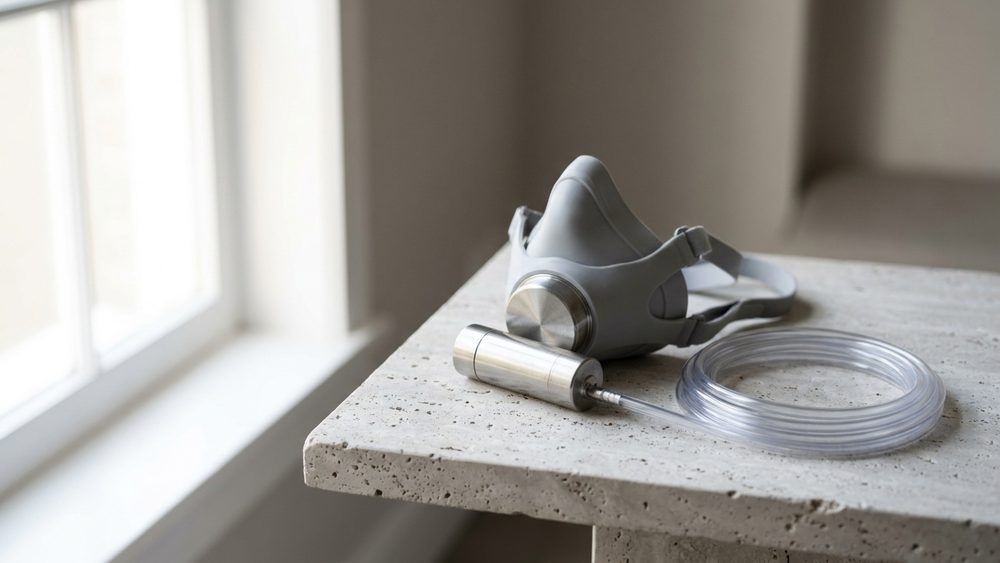
VO₂ Max / Cardiopulmonary Exercise Testing (CPET) is now available at Longevium Clinic Dubai — one of the most informative methods for objectively assessing cardiorespiratory fitness and the body’s functional reserve.
In longevity medicine, we are interested not only in the absence of disease. It is equally important to understand how much functional reserve the body has today and how well it is likely to maintain physical activity, performance, and independence with age.
This is why the assessment of cardiorespiratory fitness plays an important role in modern preventive and longevity medicine.
What Are VO₂ Peak and VO₂ Max?
VO₂ reflects the amount of oxygen the body can take in, transport, and utilize during physical exercise.
During CPET, we measure peak oxygen uptake — VO₂ peak, which is the highest oxygen consumption actually achieved by an individual during the test. If appropriate physiological criteria are met during maximal exercise, including a plateau in oxygen uptake, the result may be classified as VO₂ max.
In clinical practice, VO₂ peak is often the primary measured parameter, particularly in individuals who do not reach a true physiological maximum.
This single measurement reflects the integrated function of several systems:
- the heart and circulatory system;
- the lungs and respiratory system;
- the blood vessels;
- oxygen transport by the blood;
- skeletal muscles;
- cellular energy metabolism.
For this reason, CPET does not assess just one organ. It provides insight into the body’s ability to function as an integrated system under progressively increasing physical stress.
Why Is Cardiorespiratory Fitness So Important for Longevity?
Cardiorespiratory fitness is one of the most extensively studied functional health indicators associated with long-term health outcomes. Large studies consistently demonstrate an association between higher cardiorespiratory fitness and a lower risk of cardiovascular disease and premature mortality.
Importantly, aerobic capacity is not a fixed characteristic. It can be influenced through regular physical activity, appropriately designed exercise, improvements in body composition, metabolic health, and lifestyle.
This is particularly relevant in longevity medicine: rather than simply identifying a risk factor, we are measuring an objective and potentially modifiable parameter of health and functional capacity.
VO₂ and Biological Age
Maximum aerobic capacity gradually declines with age. However, the rate of this decline can differ substantially between individuals.
Two people of the same chronological age may have very different levels of functional reserve. For example, a physically active 55-year-old may demonstrate cardiorespiratory fitness substantially above the average for their age group, while another person of the same age may have significantly reduced functional capacity.
At Longevium, we therefore do not consider CPET to be a stand-alone “biological age test.” Instead, we use it as an important component of a comprehensive assessment of functional and biological age, alongside other clinical, metabolic, and functional parameters.
The test helps answer an important practical question: how well do your current functional capabilities correspond to your chronological age — and how much potential is there for improvement?
What Does the Test Measure?
During CPET, we can assess:
- VO₂ peak — the highest oxygen consumption achieved during the test;
- VO₂ max — when the appropriate physiological criteria are met;
- overall cardiorespiratory fitness;
- functional reserve during progressively increasing exercise;
- cardiovascular and respiratory responses to exercise;
- ventilatory efficiency and gas exchange;
- ventilatory thresholds VT1 and VT2;
- individualized exercise intensity zones;
- how your results compare with reference values for your age and sex.
The test therefore provides considerably more information than a simple measure of physical endurance.
How Is the Test Performed?
The assessment is performed on a cycle ergometer with progressively increasing workload.
During the test, the patient exercises while wearing a specialized gas-analysis mask. The system measures oxygen consumption and carbon dioxide production and evaluates how the body responds as exercise intensity increases.
Depending on the protocol and medical indications, additional physiological parameters may also be monitored throughout the assessment. This allows us to evaluate not only the final VO₂ peak but also how the body adapts physiologically at different levels of exercise intensity.
Personalized Training Zones Instead of Generic Recommendations
One of the most practical benefits of CPET is the ability to determine individualized exercise intensity zones.
Standard formulas based primarily on age and estimated maximum heart rate do not account for individual differences in metabolism, physiology, it is important not only to create an intervention plan but also to objectively measure whether it is working. Your first CPET assessment provides an individualized baseline.
After several months of regular exercise and lifestyle optimization, the test can be repeated to objectively determine: has cardiorespiratory fitness improved, has VO₂ peak increased, and has the body’s functional reserve become greater?
For individuals following a targeted exercise program, repeating the assessment after approximately 3–6 months can be useful for evaluating progress and adjusting the training strategy if necessary. Once fitness and health are stable, reassessment may be considered approximately once a year as part of a comprehensive longevity assessment. The optimal interval should always be individualized according to age, health status, baseline fitness level, and personal goals.
Who Can Benefit From VO₂ Max / CPET?
VO₂ Max / CPET is not only for professional athletes. It can be particularly useful for people who want to:
- objectively assess their cardiorespiratory fitness;
- understand their functional reserve;
- complement a comprehensive assessment of biological and functional age;
- determine personalized exercise zones;
- improve endurance and physical performance;
- develop a more precise training program;
- evaluate whether their current exercise strategy is effective;
- monitor changes in physical fitness with age;
- build a personalized strategy for healthy and active longevity.
Longevity Is About More Than the Number of Years We Live
One of the central goals of modern longevity medicine is to extend healthspan — the period of life during which a person remains healthy, physically active, productive, and functionally independent.
This is why, alongside laboratory biomarkers, body composition, metabolic health, and other clinical parameters, we also need to assess what the body is actually capable of doing. CPET allows us to measure this functional reserve, establish an individual baseline, and track meaningful changes over time.
At Longevium Clinic Dubai, VO₂ Max / CPET is performed with a professional interpretation of the results. The findings allow us to assess cardiorespiratory fitness, compare it with age- and sex-specific reference values, and identify areas for further improvement in physical performance and healthy longevity.
We cannot change our chronological age. But many aspects of our functional age can be measured, trained, and improved.